Oral testimony
Descendants and community members are approached as holders of knowledge and interpretation, not as material to be fitted into a pre-written narrative.
Liverpool · Memory · Sound · Public History
History did not end in 1946.
INJUSTICES 1946 is a Liverpool-born cultural research and storytelling project exploring how historical injustice survives in lives, families and public memory.
Our work begins with the forced repatriation of Liverpool’s Chinese merchant seamen and the generations that followed, while building a framework for other overlooked histories of racism, displacement, institutional injustice and community struggles for recognition.
01 · Before 1946
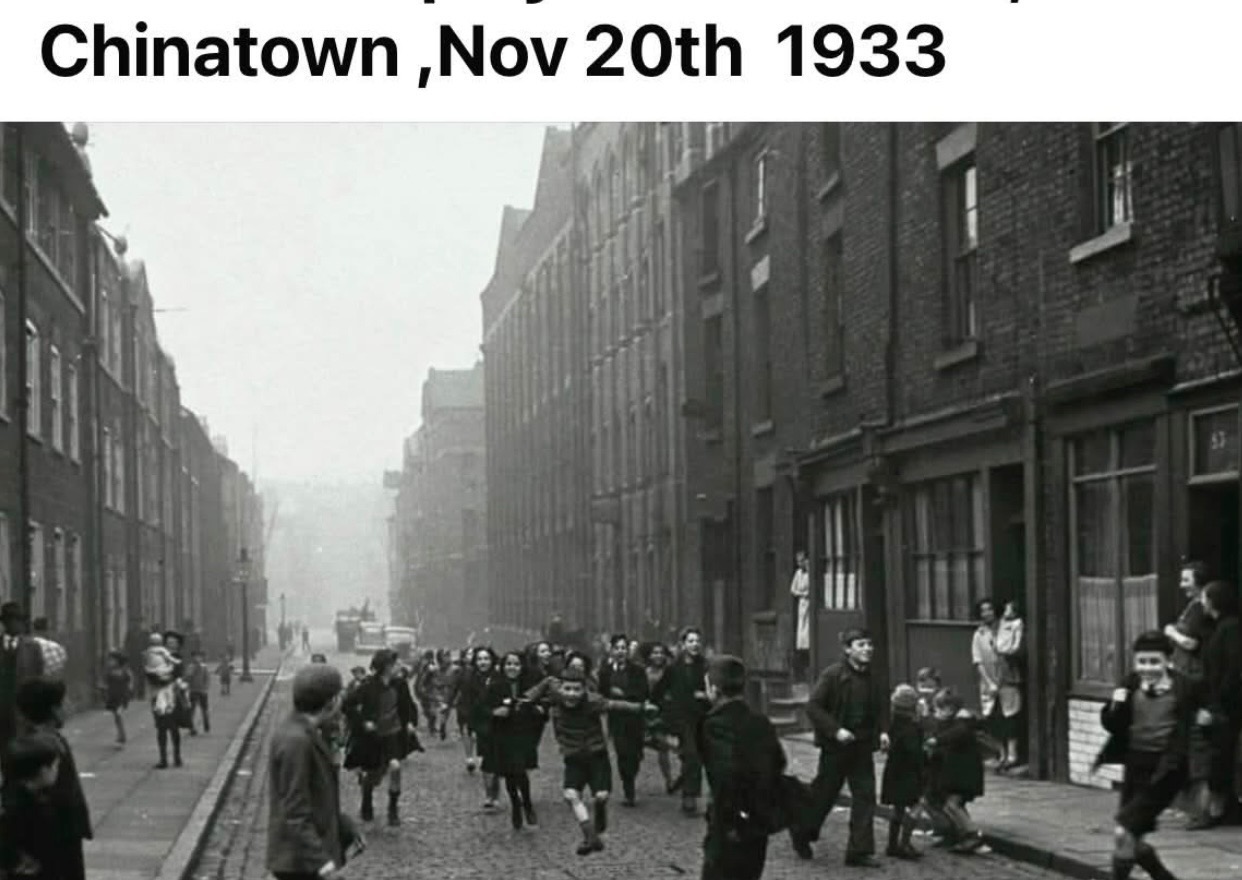
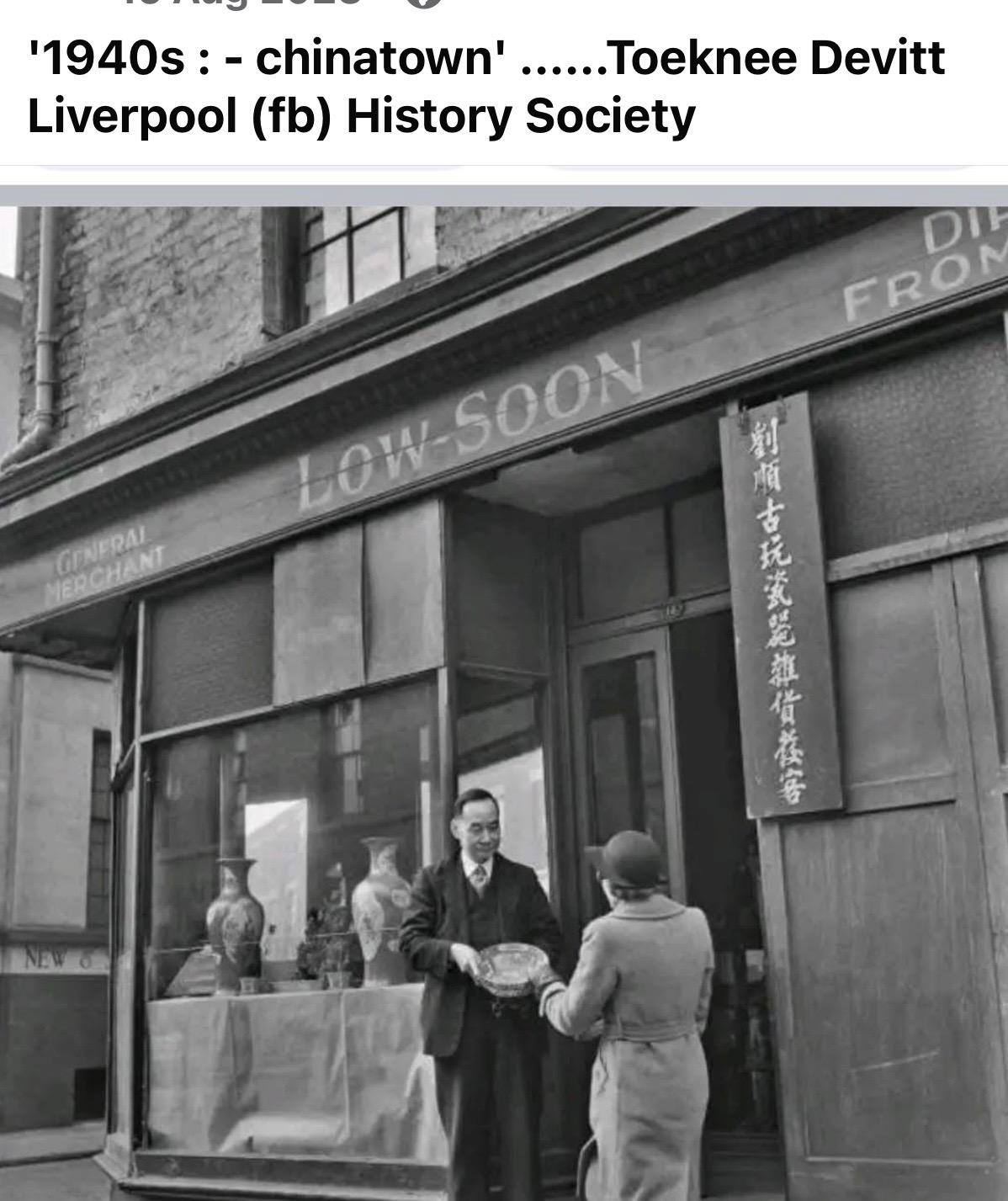
Liverpool’s Chinese presence did not begin with deportation. Before 1946, seamen, workers, businesses and families were already part of the social life of the city.
Chinese merchant seamen in Liverpool were removed from Britain through a government repatriation operation, separating families and leaving many partners and children with little or no explanation.
Families left behind
Many Chinese seamen had formed relationships and families with local white British women. Some of these women faced hostility or rejection from their own relatives and communities because of their relationships with Chinese men. After the removals, many were left raising children alone while believing they had been deserted.
The seamen are the historical foundation of this project, but our inquiry does not stop at the moment of removal. We ask what disappearance meant inside a family, what children were told, what later generations inherited, and why some answers took decades to reach them.
The men are where the history begins. The generations that followed are where its consequences continue.
A wider history
The surviving record is incomplete and published figures vary. This timeline brings together the most consistently documented stages of the story.
Shipping routes between Liverpool and Chinese ports brought seamen to the city. Boarding houses, shops, associations and families became part of the life of Liverpool’s historic Chinatown.
Thousands of Chinese seamen served through Liverpool during the Second World War, keeping Britain supplied while facing dangerous work and lower pay than many British crewmates.
The Liverpool Chinese Seamen’s Union organised a strike over wage inequality and the war-risk bonus. The men won improvements, but official and commercial records increasingly cast organised seamen as troublesome.
A Whitehall meeting led to Home Office file HO 213/926, titled “Compulsory repatriation of undesirable Chinese seamen”. The policy was not publicly debated and families were not informed.
Police, immigration officers and shipping companies helped remove men from Liverpool and place them on departing ships. Some left voluntarily, but evidence records raids, detention and forced removal. Wives and children were denied a chance to say goodbye.
Women were left to support families alone. Children grew up amid poverty, racism, disrupted cultural inheritance and the belief that their fathers had deserted them. Some entered children’s homes, and many learned the truth only late in life.
Documentaries, declassified records and descendant-led research brought the operation back into public view. A memorial plaque was installed in 2006, but families continue to seek missing answers, fuller recognition and an official apology.
02 · After 1946
The consequences of 1946 continued through paternal absence, inherited misinformation, racism, interrupted cultural inheritance and unresolved questions of identity and belonging.
Lives shaped by absent fathers and explanations that were often incomplete or unavailable.
Private family knowledge surviving beside, outside or in tension with official records.
Identity, belonging and the emotional labour of making sense of a history discovered late.
The continuing work of asking what happened, who knew, and what public acknowledgement should mean.
 View photograph ↗
Family photographs & objects
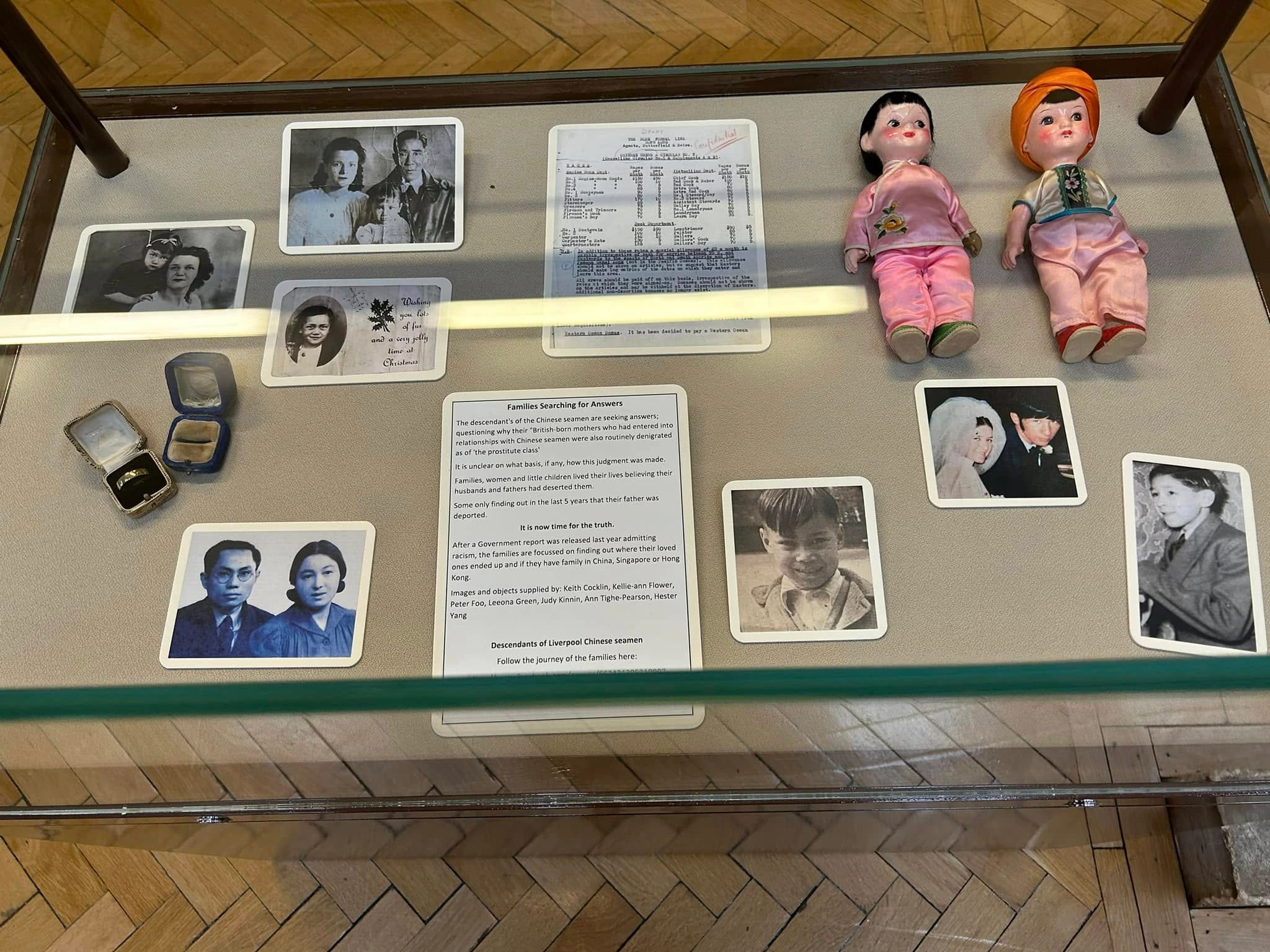
Dolls, rings and family photographs are brought together in an exhibition display about families searching for answers. Alongside testimony, such objects invite us to consider the intimate lives behind a public history of separation.
Exhibition photograph supplied by Joe Phillips (Sze). The objects are shown in their exhibition setting.
03 · Featured work
The first featured sound work from INJUSTICES 1946
A testimony-led spatial sound work by Kristina Chen, developed from first-person accounts by Yvonne Foley and Joe Phillips (Sze), environmental recordings, archival traces and experimental composition.
Rather than reconstructing the deportations through fictional historical sound, the work begins with what remains: testimony, partial memory, recordings of place and recurring sonic fragments. It asks how absence, cultural distance and incomplete knowledge can be encountered through listening without turning trauma into spectacle.
This excerpt moves through the descendants’ discovery of what happened to their fathers and into questions of cultural inheritance, wartime service, the prejudice faced by women and mothers left behind, and unresolved identity. Recurring sea shanties create a maritime thread through the testimony, while Morse code returns as an unanswered intergenerational question.
Listen to the excerpt
Selected from 10:40 to the end of the full composition, where testimony, maritime song and recurring Morse code converge.
The audio could not play. Please try again, or open the audio file below.
Open audio file ↗04 · Research approach
Listening is not simply how our work is consumed. It is part of how we research, edit and decide what not to claim.
Descendants and community members are approached as holders of knowledge and interpretation, not as material to be fitted into a pre-written narrative.
Documents establish context, but are read alongside family memory, contradiction and what official records leave unsaid.
Proximity, distance, recession and movement become compositional ways of thinking about cultural distance, place and unstable memory.
The work refuses to fabricate the lost sound of the deportations. Sound supports testimony without pretending to recover an irrecoverable past.
Gaps, silences and incomplete records are not problems to disguise. They are part of the historical condition. Our practice asks how to make those absences perceptible without filling them with invented certainty.
05 · Memory in public
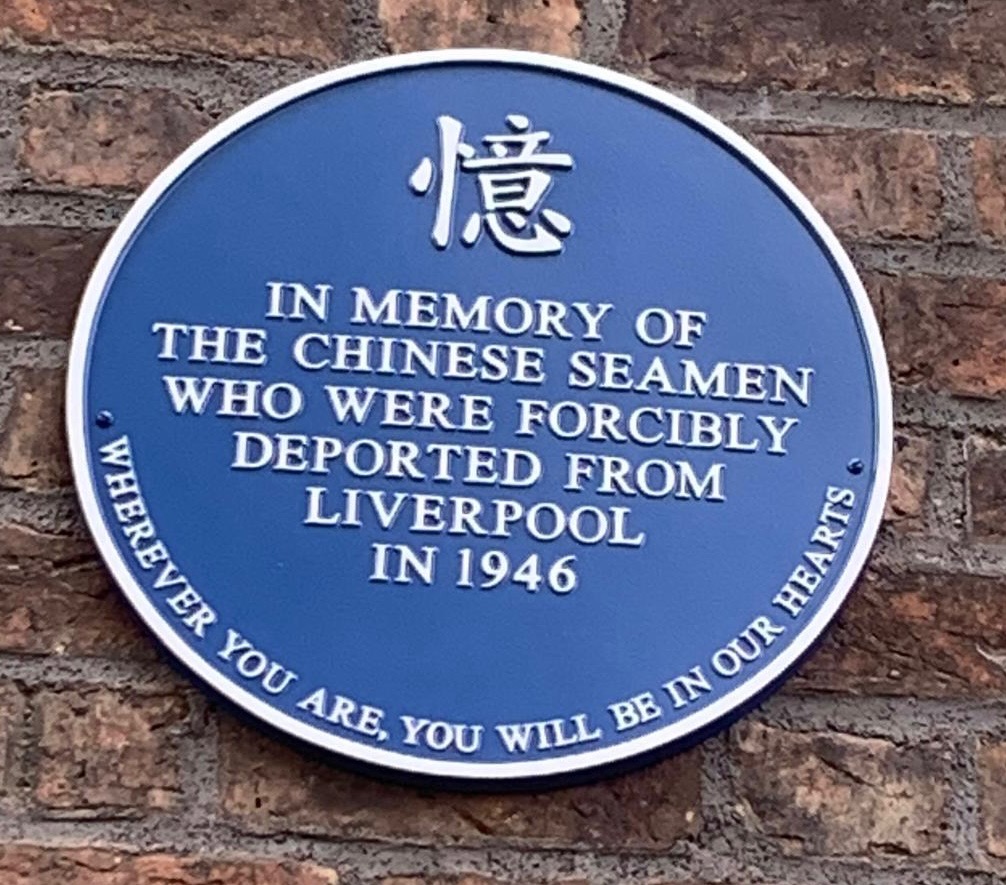
“Wherever you are, you will be in our hearts.”
The memorial plaque gives the history a place in Liverpool’s public landscape. Its inscription also speaks to something the archive cannot contain: the private endurance of absence within families.
For INJUSTICES 1946, commemoration is not a closing gesture. It is a point from which living memory, testimony and the continuing search for recognition can be heard.
Around the memorial
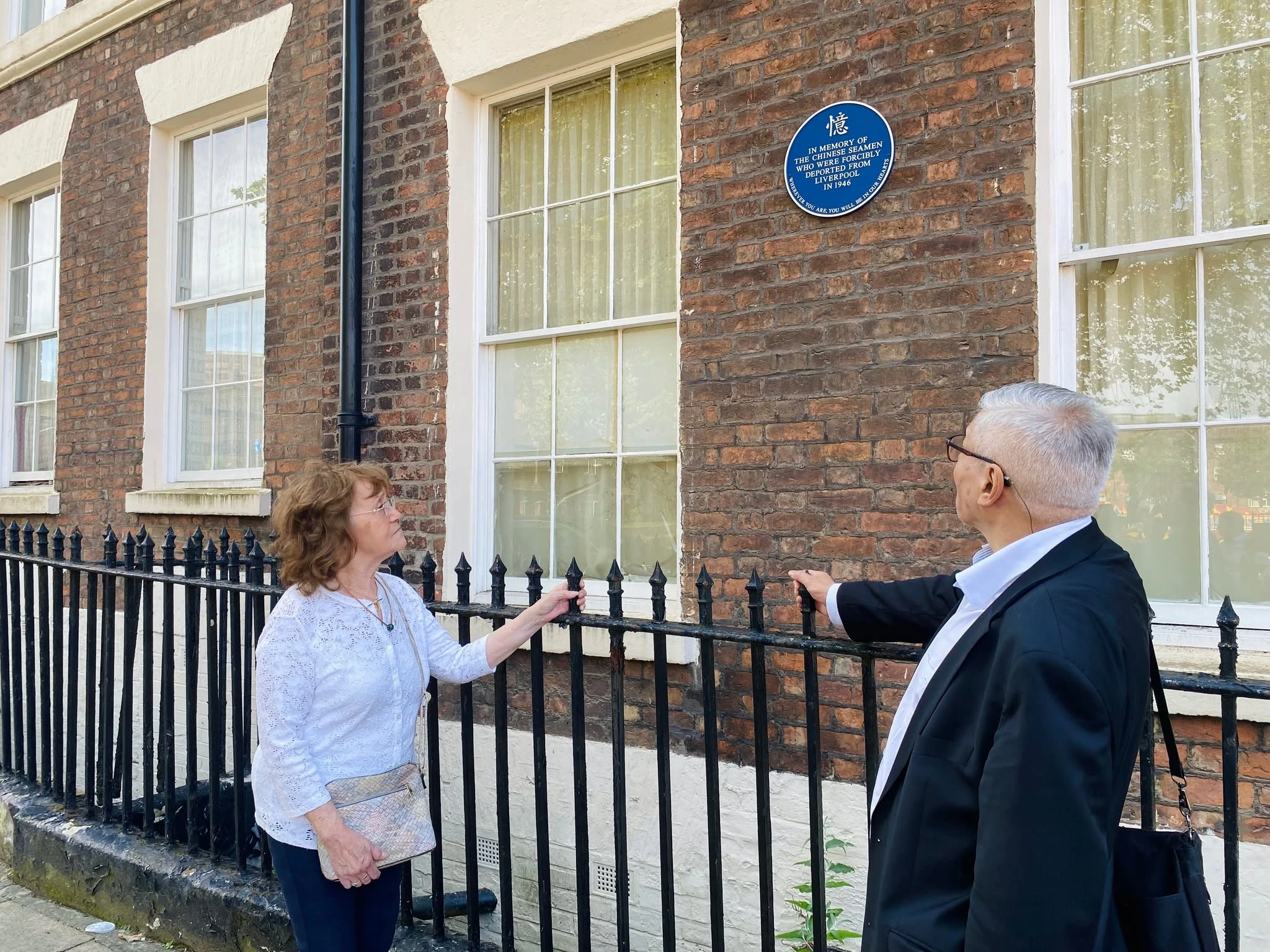
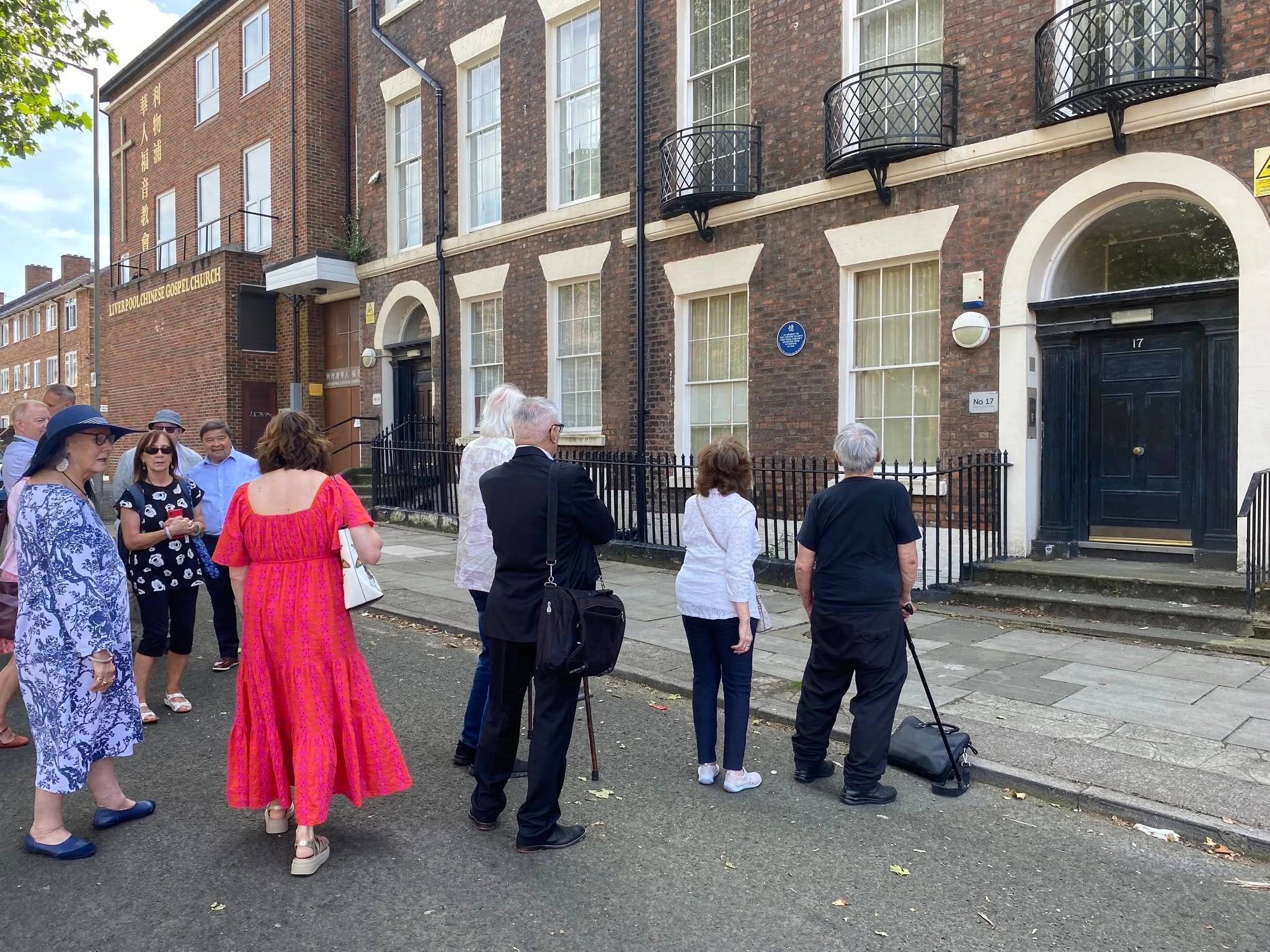
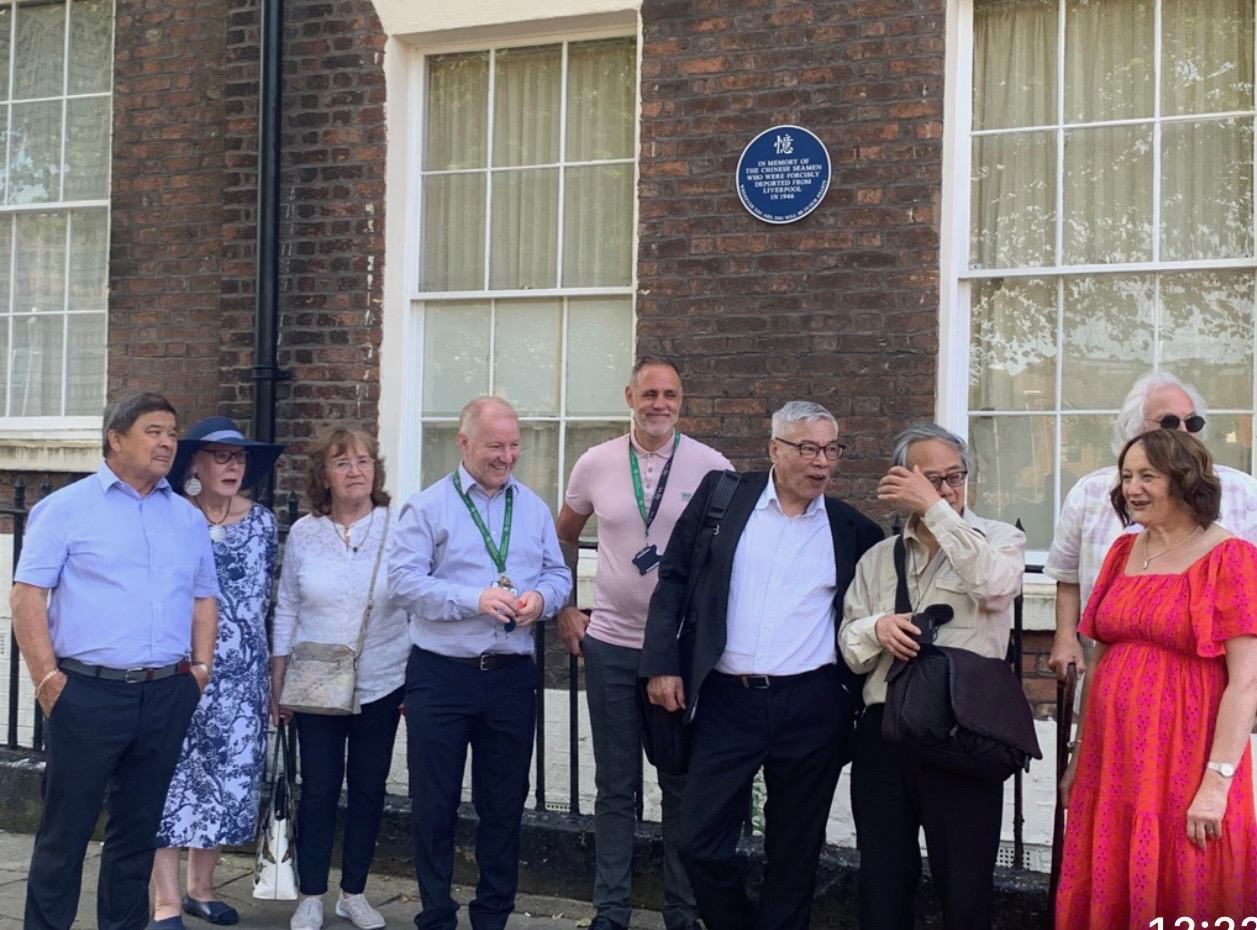
The plaque is part of a living social landscape. These photographs bring the people and conversations around it into view.
 View photograph ↗
A conversation beside the plaque remembering the Chinese seamen forcibly deported from Liverpool in 1946.
 View photograph ↗
People gathered near the memorial. Remembering also happens through meeting, talking and spending time together.
 View photograph ↗
Community members gathered beneath the memorial plaque. Public memory is carried by living people.
New community photographs supplied by Joe Phillips (Sze). They document gatherings around the memorial, not events attributed to INJUSTICES 1946.
06 · Archive
Historical records sit beside oral testimony, family material, photographs, objects and place-based memory. The archive grows as relationships and research develop.
Government records, contextual research and historical traces.
First-person accounts and intergenerational family narratives.
Photographs, locations, objects and memories that carry histories outside official files.
Talks, community events and cultural work that bring these histories into public conversation.
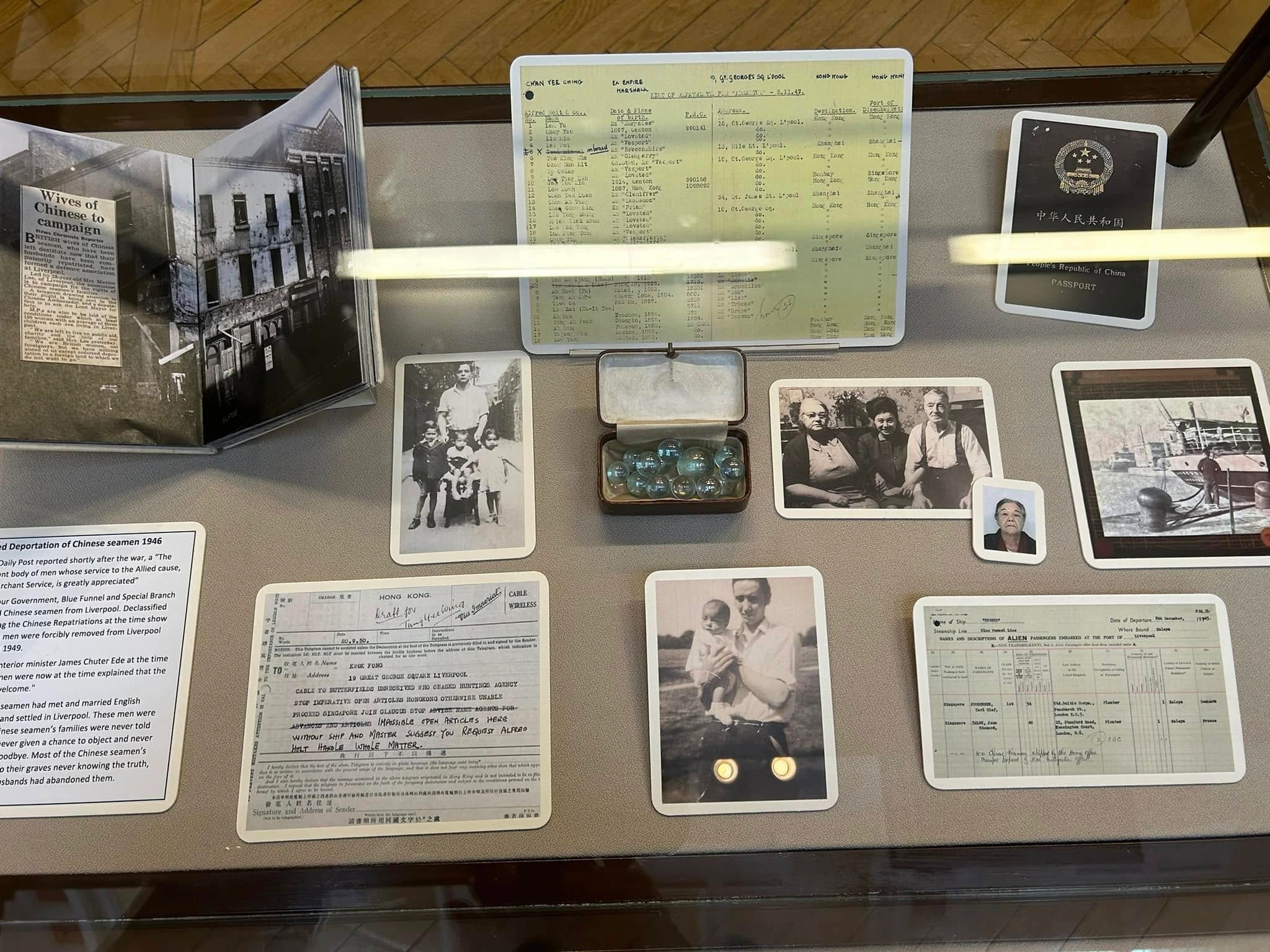 View photograph ↗
Documents, photographs and objects displayed side by side. A photographed exhibition case offers a view of how different kinds of evidence can be brought into conversation.
Community collections
Family albums, learning materials and everyday objects also speak to the wider life of Liverpool’s Chinese community. These exhibition photographs provide context, rather than identifying every item with the 1946 removals.
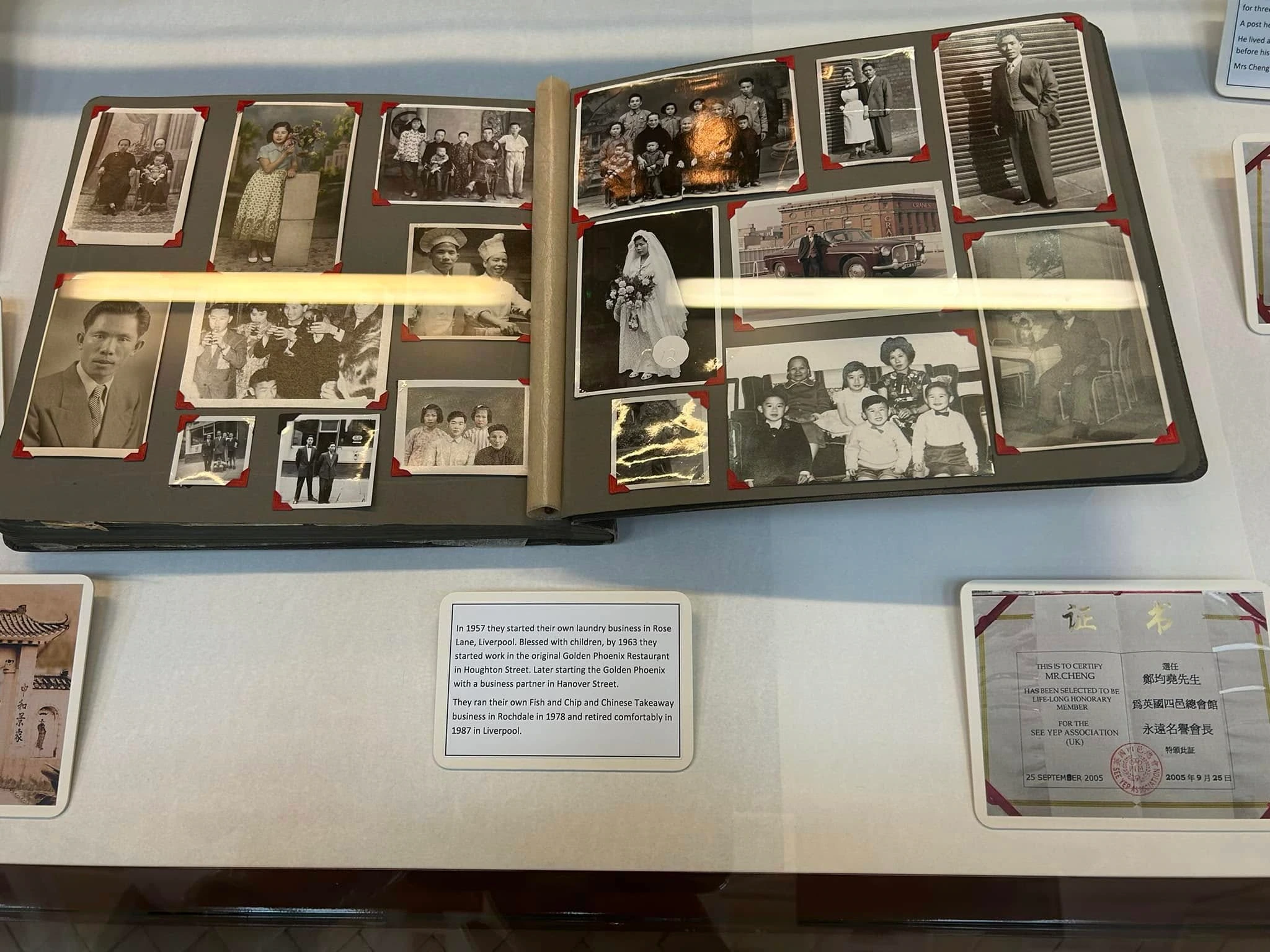 View photograph ↗
An open family album on display. Portraits and photographs of everyday occasions offer another way into the history of a community.
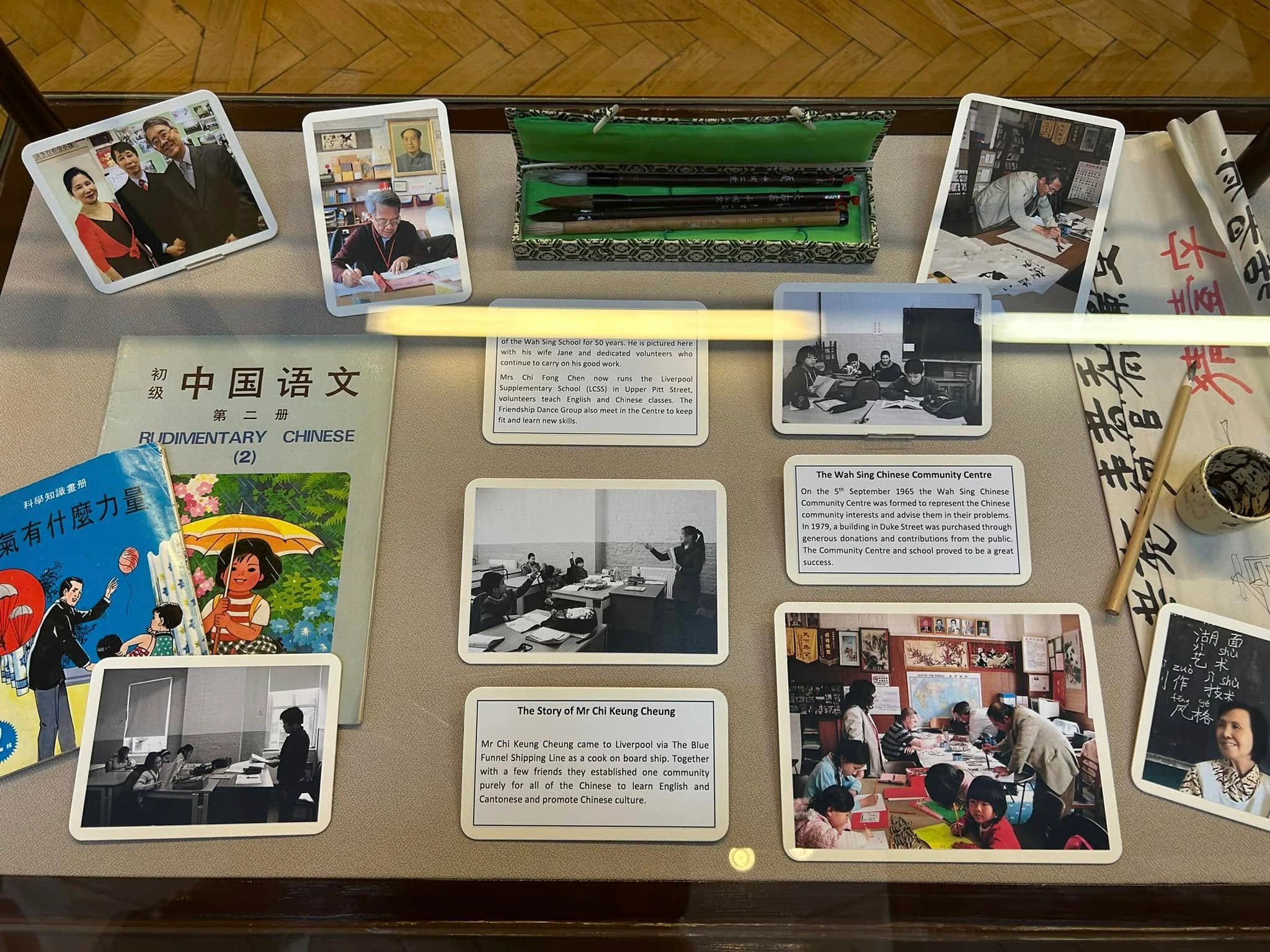 View photograph ↗
Textbooks, brushes and photographs of classes place education and cultural life within the wider story of Liverpool’s Chinese community.
Exhibition photographs supplied by Joe Phillips (Sze). They show existing displays, not collections held by INJUSTICES 1946. Original exhibit labels and credits remain visible in the enlarged photographs.
View the community heritage talk poster ↗07 · Read, listen, watch
No single article, programme or archive can contain this history. These selected resources offer journalism, audio, drama, documentary, family research and community perspectives.
Community interview scenes
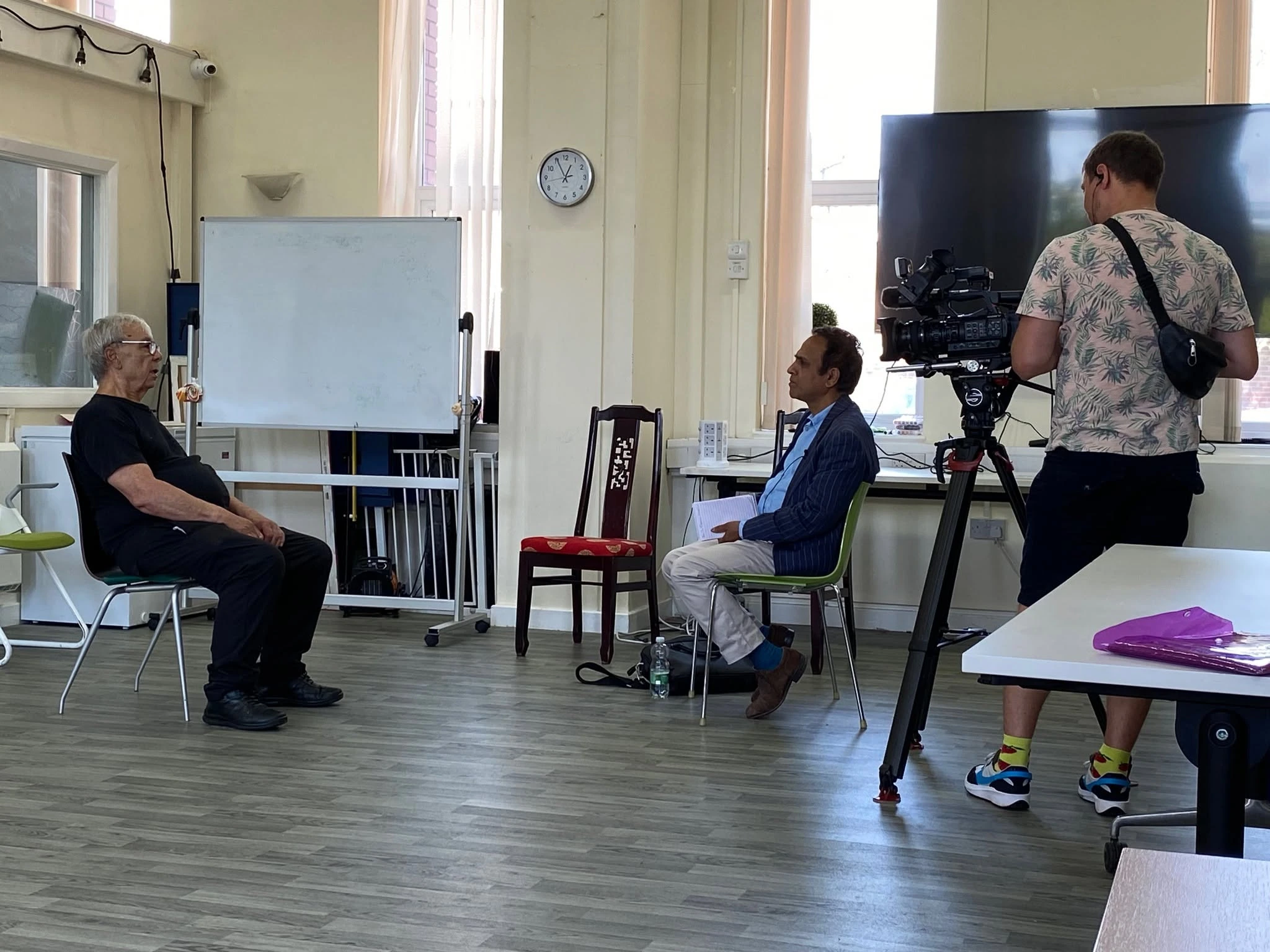
These interview photographs, shared by Joe Phillips, offer a glimpse of the conversations through which experiences are recorded. Explore the independent reporting, audio and documentary below.
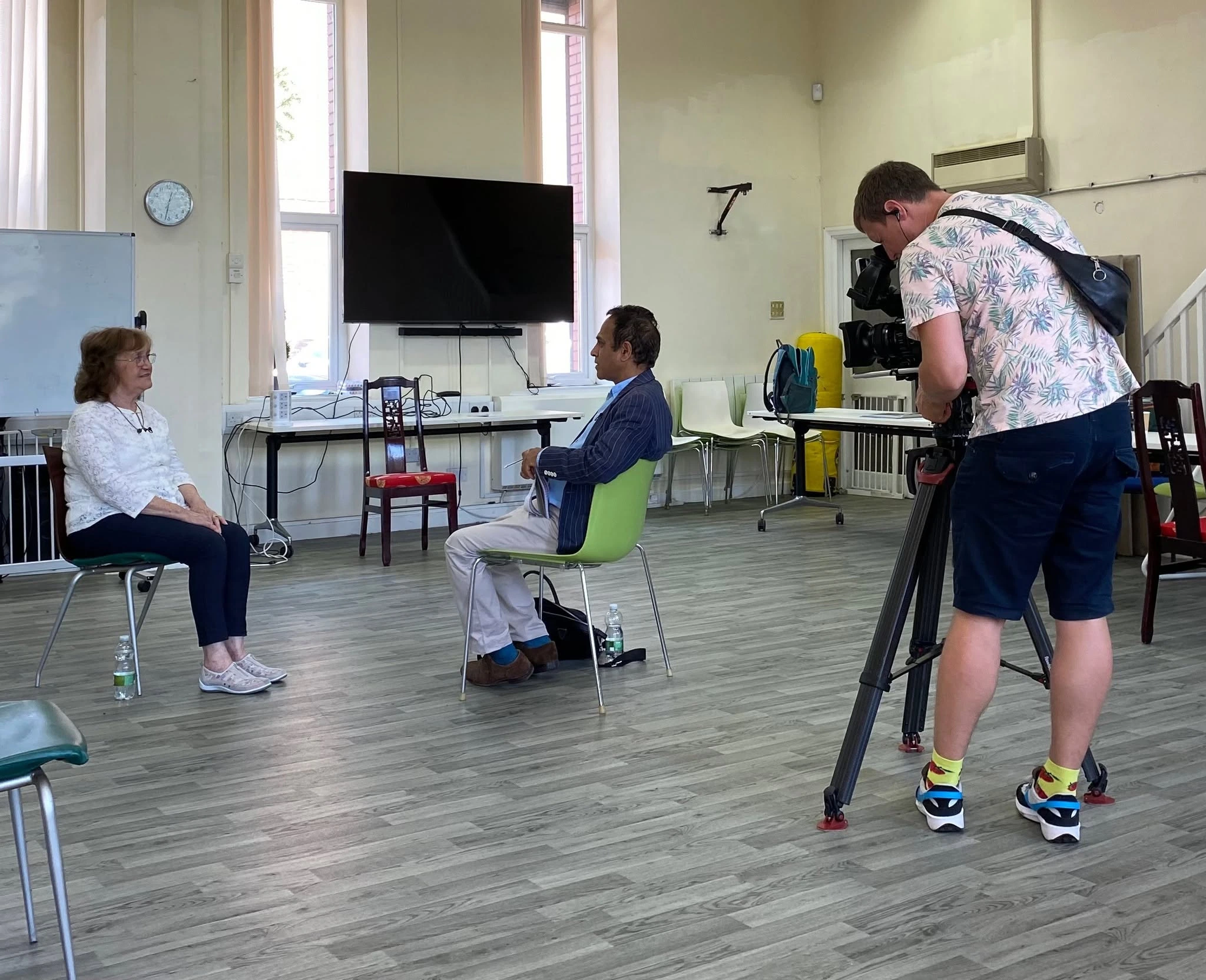 View photograph ↗
A participant and interviewer in conversation, with a camera operator recording the exchange.
 View photograph ↗
Another interview scene from the photographs shared with the project. Listening begins with time and attention to the person speaking.
Photographs supplied by Joe Phillips (Sze). These community interview records are not presented as INJUSTICES 1946 productions or as images from a particular programme listed below.
New perspectives
A family search, a photographic exhibition, a documentary and a Chinese-language account open the history through different forms and viewpoints.
Yvonne Foley’s search moves from a childhood revelation to archives in Britain, Australia and China, revealing why her father disappeared and how families began recovering the history.
Read BBC feature ↗A review of Open Eye Gallery’s exhibition, connecting Bert Hardy’s 1942 seamen portraits, Martin Parr’s 1985 Chinatown photographs and community oral histories.
Explore exhibition review ↗Part one of The Exiles follows children of Chinese seamen forced out of Britain after the war, placing family testimony alongside the institutional decisions that separated them.
Watch documentary ↗A Chinese-language overview of the seamen’s wartime contribution, unequal treatment, the secret postwar removals and the long wait for recognition.
Read Chinese report ↗Selected collection
Nine further resources bring together journalism, drama, podcasts, documentary work, photography and descendant-led research.
A detailed long read tracing the wartime contribution of Chinese seamen, the secret Whitehall decision, the removals and the descendants’ search for truth.
Open article ↗Yvonne Foley speaks about discovering her Chinese heritage and searching for the father she never knew in this episode of Today in Focus.
Open podcast ↗A drama inspired by the forced repatriations, moving between a family’s wartime life in Liverpool and a daughter’s later attempt to understand her father’s disappearance.
Open BBC programme ↗A documentary investigation and three-part podcast following the sailors’ service, the postwar removals and families’ continuing pursuit of truth and justice.
A photograph-led account of Chinese seamen in 1942 Liverpool, their equal-pay strike and the later campaign led by descendants including Yvonne Foley.
Open photo story ↗Coverage of a Liverpool flower-laying ceremony at the memorial plaque shows how families and community members continue to remember the seamen publicly.
Open news story ↗Research, documents and family stories assembled by Yvonne Foley and the community of descendants who worked to recover what happened.
Open archive ↗An accessible exhibition placing the 1946 deportations within the wider history of mixed families, wartime Britain and the children left behind.
Open exhibition ↗Witness History speaks with Yvonne Foley about the Chinese merchant seamen who served Britain during the Second World War and were then forced to leave Liverpool after the war.
Open BBC podcast ↗08 · People
INJUSTICES 1946 brings together sound practice, anthropological research, family knowledge, community connection and cultural storytelling.

Executive Producer · Sound Designer & Researcher
Kristina Chen is a sound designer and researcher working across oral history, documentary practice, spatial audio and sonic anthropology. Her work is interested in overlooked histories and in how listening can create encounters with memory that conventional narration cannot.
Her current research centres Liverpool’s Chinese community and the intergenerational consequences of the 1946 repatriations. She trained in Recording Arts before completing postgraduate study in Anthropology at UCL, where this project’s first immersive sound work was developed.
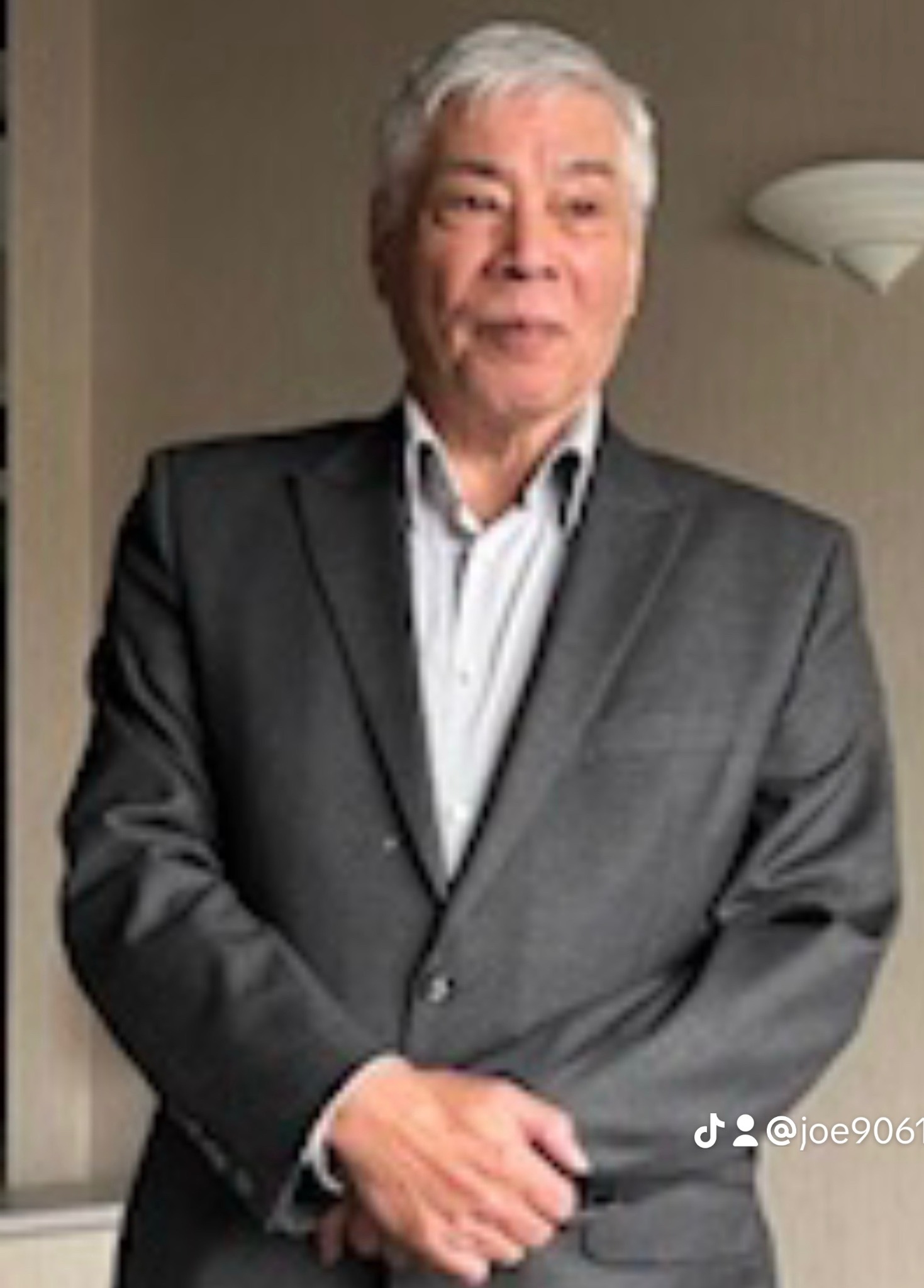
Business Executive
Son of a Chinese merchant seaman forcibly repatriated from Liverpool.
Joe’s connection to INJUSTICES 1946 is both personal and collaborative. For decades he believed that his father had voluntarily abandoned the family; learning that his father had been forcibly removed transformed how he understood his own family history and Chinese heritage.
His testimony forms part of What the Sea Refused to Tell. Within INJUSTICES 1946, Joe also brings family knowledge, community relationships, public engagement and business experience to the project’s long-term development.
09 · Our symbol
The Liver Bird does more than locate the project in Liverpool. In our emblem it connects the city to its maritime history — to movement between sea and city, departure and home, migration and belonging.
Placed at the centre of the balance, the bird also becomes a witness and a fulcrum. Liverpool is not simply the backdrop to these histories; it is the place from which they are held, remembered and reconsidered.
The two suspended forms recall the British and Chinese family histories from which our first investigation emerged. They are not intended to weigh one nation against another. The balance represents the distance between official record and lived memory, between histories publicly recorded and experiences carried privately across generations.
1946 marks where INJUSTICES began, not where its stories must end.
10 · Beyond one event
INJUSTICES 1946 began with one history in Liverpool, but the questions it raises extend beyond a single community: who is heard, who is believed, what institutions record, what families carry, and how recognition is won.
Future work will explore overlooked experiences of racism, migration, displacement, labour, family separation, institutional injustice and community struggles for truth across Britain. Potential strands may include racialised migration histories such as Windrush and other community-led campaigns for recognition, while each history will be researched on its own terms.
The 1946 repatriations remain our founding story and central body of work. They also establish the approach that guides what comes next: begin locally, listen closely, research carefully, and bring lived experience into public conversation.
11 · Our mission
INJUSTICES 1946 uses research, testimony, sound and cultural storytelling to bring overlooked histories of injustice into public memory. We challenge racism, inequality and exclusion by creating accessible ways for communities and audiences to encounter histories whose consequences continue into the present.
Restore attention to histories and experiences that have been omitted, distorted or left at the margins of public memory.
Oppose racism and discrimination in all forms, while recognising the specific histories and structures through which inequality is produced.
Begin with lived experience, family memory and community knowledge rather than treating people as illustrations of a pre-written story.
Research carefully, acknowledge uncertainty and remain responsible to contributors as stories move into public circulation.
12 · Community support

Podcast venue support
The Black-E is an arts and community centre in Liverpool, connecting artists and communities through participation, creativity and cultural exchange.
We are grateful to The Black-E for offering space to support the development of our forthcoming podcast. Beginning with the children and families of the Chinese seamen forcibly repatriated from Liverpool, the podcast will explore personal testimony and wider questions of racism, belonging and equality.
Explore The Black-E ↗13 · Contact
We welcome contact from descendants, community members, researchers, cultural organisations, commissioners, potential partners and funders.
This form sends your details, story and permission choices to the INJUSTICES 1946 team through Netlify Forms. Submissions are accessed through the project’s private Netlify account and are not added to this public website. Access should be limited to people handling contributions. The form records the consent wording version and your selected language alongside your choices. We do not store your story in browser storage. If you leave the page before submitting, your text may be lost. For questions about access, correction, deletion or permissions, contact contact@injustices1946.com.
To change your choices or request deletion, email contact@injustices1946.com. You can withdraw permission for future use; copies already shared by others may not be recoverable.
Netlify privacy policy ↗